
Printing 2D barcode labels: what GS1 Sunrise 2027 really changes
GS1 Sunrise 2027: what changes for printing 2D barcode labels in chemicals and pharma? See what you can check today, and ask us for advice.
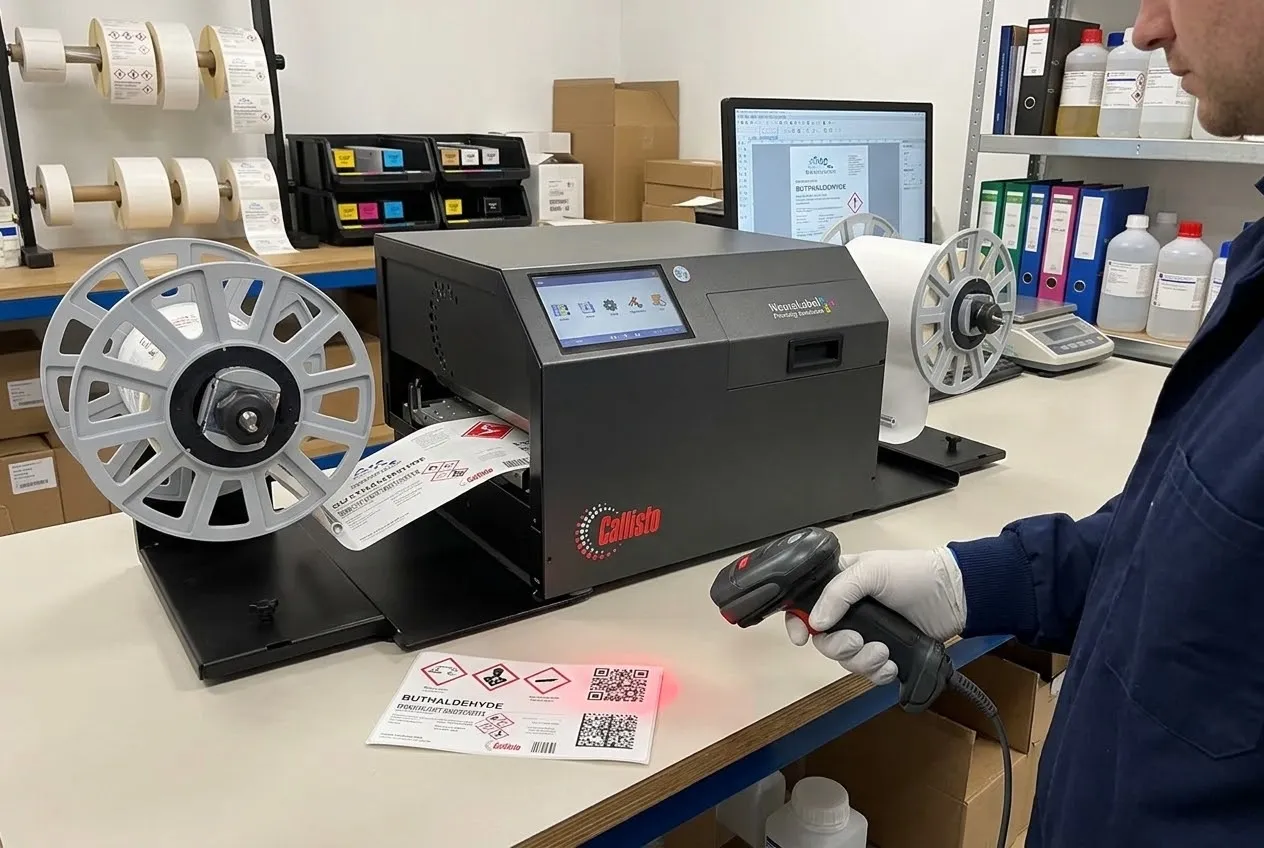
By the end of 2027, checkouts all over the world need to be able to read a 2D barcode, alongside the linear barcode you already know. No reason to panic, but a good moment to check whether printing 2D barcode labels will still go smoothly for you. In this article you will read what GS1 actually says, what it means for chemicals and pharma, and which checks you can already run on your own labels.
First, the nuance: Sunrise 2027 is about scanning at the checkout (retail). Much of what you label in chemicals and pharma never passes a shop till. But the standards, the scanners and your customers’ expectations are shifting with it. If you know now what is coming, you won’t have to scramble later.
What is GS1 Sunrise 2027?
GS1 is the organisation behind the barcode standards we use every day. Its “2D in retail” guideline puts the goal like this: by the end of 2027, point-of-sale systems worldwide should be able to read and process the GTIN from both the existing linear barcodes and 2D barcodes (the so-called “Ambition 2027”).
Two things that are often misunderstood:
- It is a goal for the scanners, not a ban on linear barcodes. GS1 itself writes that linear barcodes will remain as long as there are applications for them.
- It is about retail. For regulated healthcare products, GS1 refers to GS1 DataMatrix and to a separate position paper.
According to GS1 Belgium & Luxembourg, brand owners may put a 2D code next to the linear barcode during the transition period. By the end of 2027, the expectation is that only one next-generation barcode will remain on the label.
Which 2D barcodes count?
For retail, GS1 names three options alongside the existing linear codes (EAN/UPC and GS1 DataBar):
- GS1 DataMatrix
- Data Matrix with GS1 Digital Link syntax
- QR code with GS1 Digital Link syntax
For healthcare products, GS1’s retail guideline names GS1 DataMatrix as the 2D code of choice. Additional GS1 guidelines apply to product identification in healthcare. A QR code can, where relevant, provide additional digital product information, but it does not simply replace the identification barcode. Check this with your quality manager.
So a regular QR code with any old link is not the same as a QR code that puts the GTIN in the URL according to GS1 Digital Link. Mix them up and you get a nice little square that the checkout doesn’t understand.
What does this mean for chemicals and pharma?
Three things to remember.
- First check whether your product will ever reach a retail checkout. An IBC label for a plant in Antwerp has different requirements than packaging in a pharmacy or drugstore. Regulated pharmaceutical products have their own rules, and there GS1 DataMatrix is the reference point.
- Dynamic data changes the game. Batch number, expiry date, unique ID: once those are in the code, you need to be able to supply them at the moment of printing. Back in 2023, Domino Printing Sciences wrote that dynamic data, such as batch numbers and expiry dates, requires an adapted printing approach. When that data is only known during production, it has to be encoded at that moment. A fully pre-printed code is not enough. According to them, poor codes lead to rejects, rework and, in the worst case, recalls.
- The printer is only one link in the chain. Your label software, your ERP data and your scanner need to keep up. A code that looks good but doesn’t scan is progress for nobody.
Checklist: what can you check today?
- Which products will ever go through a retail or consumer channel, and which won’t?
- Which barcodes are on your labels now, and who decides on the switch?
- Can your label software generate a Data Matrix or a QR code with GS1 Digital Link? Check your software’s manual, not your gut feeling.
- Is there enough quiet zone around the code, and is the code large enough to scan easily?
- Do you test a printed sample label with the scanners you actually use? A smartphone can be a first check for QR codes, but whether it also reads a GS1 DataMatrix depends on the device and the app. It also doesn’t prove that the code meets quality standards. That is what barcode verifiers are for.
- Does the variable data (batch, expiry date) come from a single source?
Keep it small. One product, one label, one test round. Only then do you scale up.
Why the printer matters
A 2D code often holds a lot of information in a small area. That is why sufficiently high print resolution, good contrast and consistent print quality are important. Printer settings, label material and the size of the code also play a part. A dirty printhead can reduce readability, and you usually only notice when a scanner rejects a code. Want to know which settings your NeuraLabel Callisto needs for smaller codes? Just ask us: we’d rather look at it together than have you figure it out on a Friday afternoon.
Frequently asked questions
What is GS1 Sunrise 2027?
A global GS1 goal to get point-of-sale systems ready, by the end of 2027, to read both linear and 2D barcodes. It is not a legal requirement, and it is not the date on which linear barcodes disappear.
Do I need to change my labels now?
Not automatically. First work out whether your products end up in retail. If they do, test one sample label now, so you are not working against the clock in 2027. For regulated products, follow the rules of your sector.
What is the difference between a regular QR code and a QR code with GS1 Digital Link?
A regular QR code can point to any link. GS1 Digital Link puts the GTIN in a standardised URL, so checkouts and systems recognise the code.
Which 2D barcode do I use for pharmaceutical products?
GS1 names GS1 DataMatrix as the 2D code of choice for healthcare products. Additional rules may apply to your product, so check with your quality manager or regulator.
Can my label printer print 2D codes?
Usually, yes. But the code is created in your label software; the printer just prints it. Check that the software supports the right code syntax, and test a sample label on your own scanner.
How do I test whether a 2D code scans properly?
Print a sample label and scan it with the scanners you actually use. A smartphone can be a first check for QR codes, but whether it also reads a GS1 DataMatrix depends on the device and the app. For an objective quality check, there are barcode verifiers.
Not sure whether your labels are ready for 2D? AladinCode is happy to help, also outside the standard maintenance visit.
External sources:
- GS1, “2D Barcodes at Retail Point-of-Sale Implementation Guideline”
- GS1 Belgium & Luxembourg, “Next generation barcodes”
- Manufacturing Chemist (Domino Printing Sciences), “Pharmaceuticals: Are you prepared for the 2D code sunrise?” (22 Aug 2023)
- Unitag, “GS1 Digital Link vs QR Code: What Brands and Printers Need to Know Before Sunrise 2027”
Read also: Label printer not showing on network? 5 checks before you call anyone and Printing CLP labels in-house: what changed in 2026?