
Selection guide — five short questions
Which label printer suits your business?
You do not need to know any specifications to choose the right industrial label printer. Answer five questions about your label and your production, and you will know which of our models suits you — with the reasoning alongside.
Free and without obligation · Takes about a minute · If you do not know something, you may answer that
Question 1 of 5
01
How many labels do you print per day?
The volume decides how heavily the printer has to be built — and whether it keeps up with the pace of your production.
02
Where does the label finally end up?
Moisture, refrigeration and chemicals each place their own demands on the ink and the material.
03
How long does the label have to stay legible?
A shipping label lives for days. An industrial rating plate has to still be there years later.
04
How wide is your label?
This is the most decisive detail: the width rules models out outright. GHS labels in the chemicals industry are usually at least A5 (148 mm).
05
What material do you print on?
All four printers work with any material — as long as it has an inkjet coating. Under that coating almost anything is possible.
Our recommendation
Your recommendation
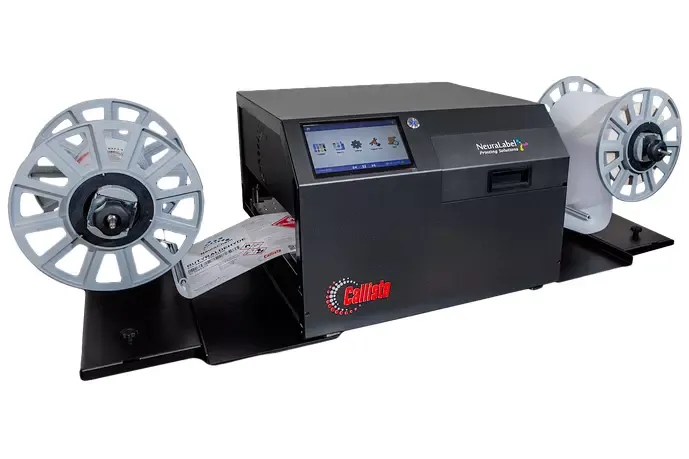
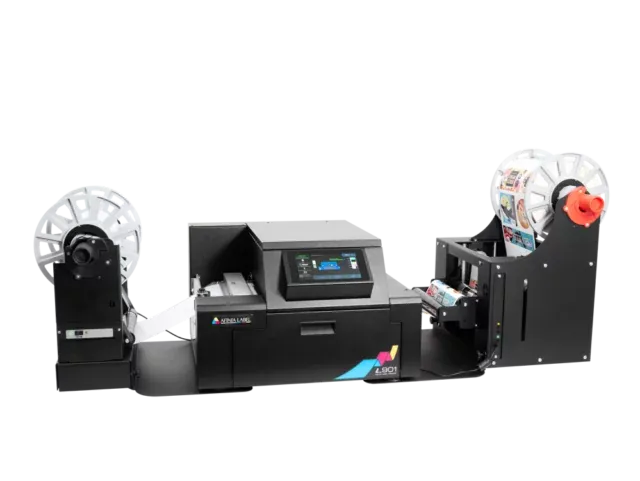
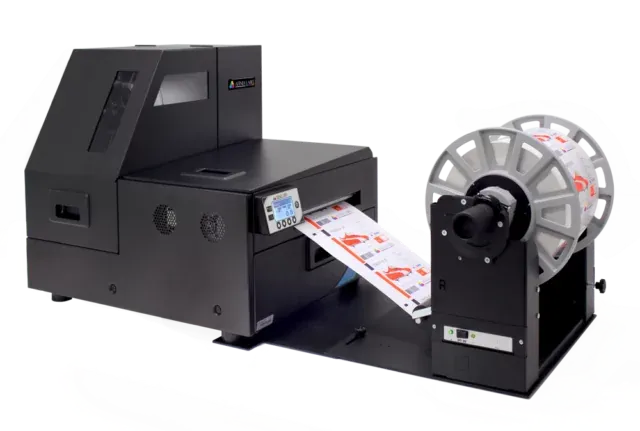
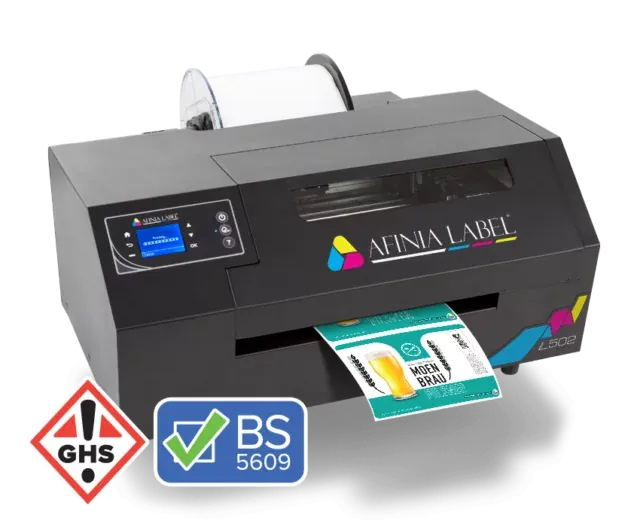
Thank you — your details have been noted. You will hear from us personally.
What do we base the advice on?
Six details decide the choice.
These are the criteria that in practice decide which industrial label printer suits a business — in order of weight. The selection guide above follows exactly the same reasoning.
- 01
Label width
The most decisive detail. Three of our models print up to 203 or 216 mm; anyone who needs wider — GHS labels in the chemicals industry usually start at A5 (148 mm) and run up to A3 (296 mm) — automatically ends up with the Callisto.
- 02
Print volume per day
Up to 200 labels a day calls for a different machine than continuous production of more than 1,000. A printer that is too light becomes the bottleneck of your line; one that is too heavy is money thrown away.
- 03
Ink type
Dye ink gives vivid colours for labels that last weeks. Pigment ink holds up for years and resists water and chemicals. That difference often already decides which model is left.
- 04
GHS and BS5609
If you label hazardous substances, your label has to meet BS5609. Within our range the NeuraLabel Callisto is the machine of choice for that.
- 05
Environment of the label
Outdoor storage, cold store, condensation or contact with chemicals: the conditions help decide which ink and which material hold up.
- 06
Material of the label
Paper or synthetic material such as PP and PE — all four printers can handle it, as long as the label has an inkjet coating. Under that coating almost any material is possible.
Would you rather talk to someone about your label straight away?
Send us your label, material and daily volume and you will get a personal answer. That is often quicker than working it out yourself — and you will know right away what it costs.