
Printing CLP labels in-house: what changed in 2026?
If you print your CLP labels in-house, you adjust the design today and print the new version tomorrow. No box of 800 outdated labels in the cupboard.
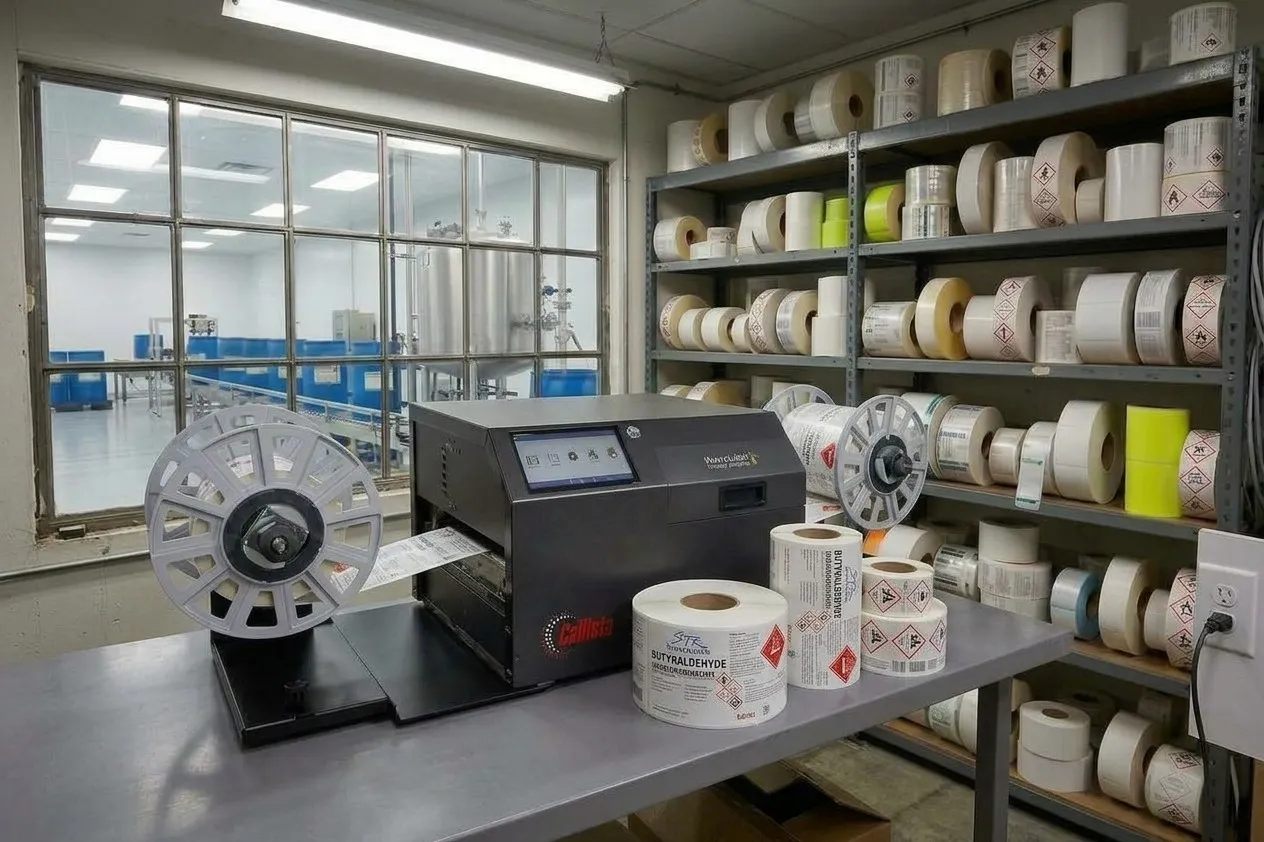
Picture this: you need 200 CLP labels for a new refill pack, and your print supplier has a minimum order of 1,000. And the legislation has just changed. If you print your CLP labels in-house, you adjust the design today and print the new version tomorrow. No box of 800 outdated labels in the cupboard.
The CLP Regulation has been revised by Regulation (EU) 2024/2865, and later amended by Regulation (EU) 2025/2439. Not everything applies from the same date. Below you can read what already applies and what has been postponed. Note: CLP covers substances and mixtures. Medicinal products are in principle not covered, so first check whether your products fall within its scope.
What has applied since 1 July 2026?
- An EU supplier on the label. The supplier must be established in the EU and be identified. So check that the name, address and telephone number of the responsible EU supplier are stated correctly.
- Fold-out labels. Their use is being extended, but under new conditions for design and content.
- Refill stations. Specific requirements apply to bulk sales through refill stations.
- Supplemental information in digital form. Under certain conditions, some supplemental information may be provided in digital form only, for example via a QR code. The mandatory CLP labelling itself stays on the physical label.
What comes later?
- From 1 January 2027: substances classified as PBT, vPvB, PMT, vPvM or endocrine disruptor must be named in the product identifier of a mixture.
- Postponed to 1 January 2028: the formatting requirements for mandatory information (such as minimum font size and line spacing), relabelling, the rules on advertising and online sales, and the exemption for small packaging. This gives companies extra time to adapt their labels and printers.
- New hazard classes. Endocrine disruptors and PBT, vPvB, PMT and vPvM substances fall under hazard classes that were already introduced by an earlier amendment (Delegated Regulation 2023/707). The application dates differ for substances and mixtures, and transitional periods apply to products that were already on the market. Check for each product which date applies to you.
Why this makes the case for printing in-house
With an industrial label printer you print CLP labels when you need them, in the quantity you need. That helps with short runs, with multiple language versions and with changes in legislation: new design, new print, old stock no longer in circulation.
Printing in-house does not, however, release you from your responsibility for correct classification and labelling. The information must be legible and indelible, the label must be firmly attached, and the ink and label material must suit the conditions in which the product is used. Not every printer is up to that.
Since 1990, Michel Grauwen has seen time and again in the sector how a change in the law separates the companies that keep their labels under their own control from the rest. Want to know which printer suits your volumes and materials? Take a look at our printers, the NeuraLabel Callisto and our page on ink and labels. Still not sure? Then try Help choosing.
Checklist: what should you check this month?
- Is the correct EU supplier (name, address, telephone number) on every label?
- Do you use refill stations or repackaged products? Then additional requirements apply.
- Is your label still legible on the smallest packaging?
- Which transitional period applies to your substances and mixtures?
- Can you adjust your label design yourself, or do you depend on a print supplier?
- Is your printer suited to the material and durability your CLP labels need?
Sources
- Regulation (EU) 2024/2865 on EUR-Lex
- FPS Public Health: FAQ for professionals on the CLP Regulation
- FPS Public Health: new European rules on classification, labelling and packaging (in Dutch)
- Council of the EU: postponement of the CLP rules to 2028
Unsure about your labels or printer? Get in touch and we will think it through with you.
Frequently asked questions about CLP labels
Can I print CLP labels myself?
Yes. There is no obligation to use a professional print supplier, as long as the label meets the legal requirements: the mandatory elements, legible, indelible and firmly attached. Responsibility for correct labelling remains with the supplier.
Since when must the EU supplier be on the label?
Since 1 July 2026, the supplier must be established in the EU and be identified on the label.
Can I put a QR code on a CLP label?
Yes. You may add a QR code or URL that refers to supplemental information. Under certain conditions, some supplemental information may be provided in digital form only. The mandatory CLP labelling must, however, stay on the physical label.
Which rules on font size have been postponed?
The specific formatting requirements for mandatory information (such as minimum font size and line spacing) have been postponed to 1 January 2028. That date may still change, so keep up with the latest situation.
What about products that are already on the market?
Transitional periods apply to them. These depend on the type of substance or mixture and on the provision concerned. Consult the official text or the FAQ of the FPS Public Health.
Are medicinal products covered by CLP?
Not automatically. CLP applies to substances and mixtures within its scope. Check for each product whether CLP applies.