
When is the NeuraLabel Callisto the right choice — and when is it not?
An honest assessment: in which situations the Callisto is the clear answer, and when you are better off with an Afinia Label L502, L801 or L901.
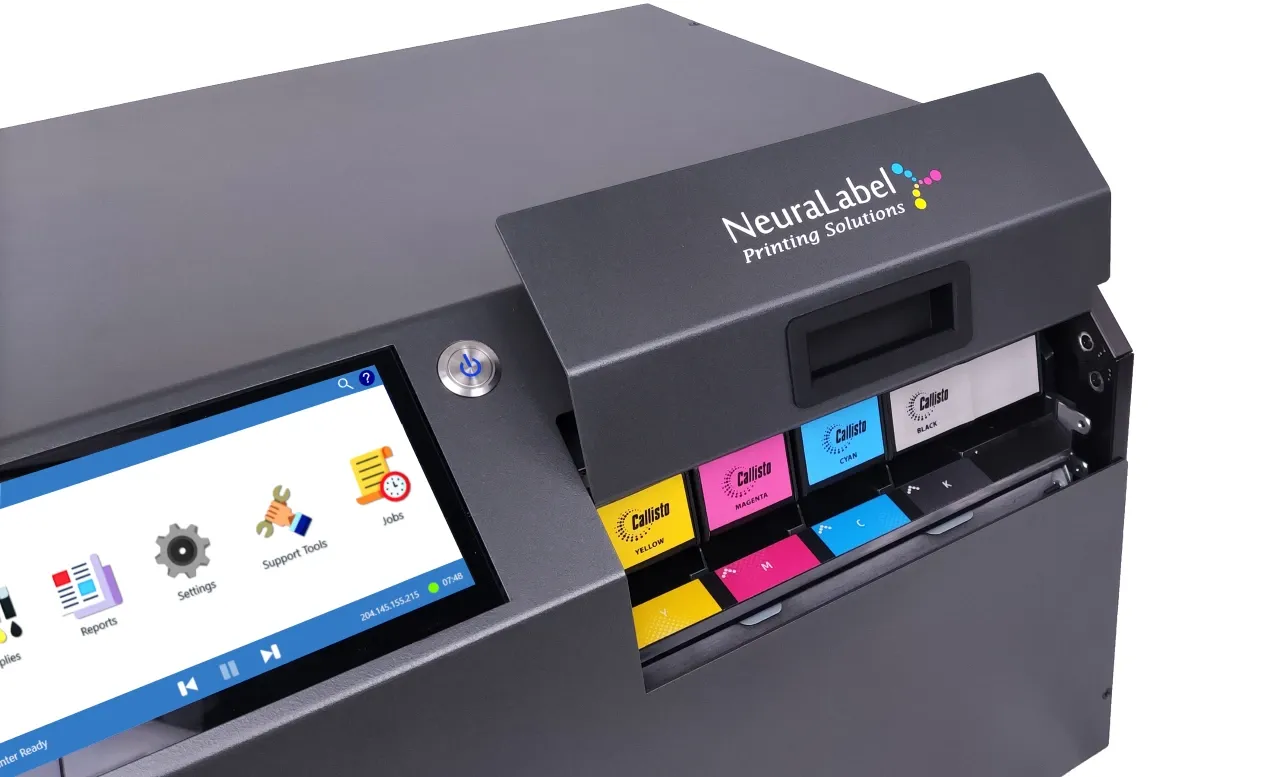
We sell the NeuraLabel Callisto, so you may expect us to talk it up. Yet that is not how we work. A machine that is sized too heavily for what a customer prints leads to dissatisfaction — and that comes back sooner or later, usually at the moment maintenance is needed.
Hence this article: an honest assessment of when the Callisto is the clear answer, and when you are better off with one of the three Afinia models.
When the Callisto is the right choice
There are four situations in which the conversation is fairly short.
1. You label hazardous substances
If your label has to meet BS5609 — ninety days of seawater, UV exposure, abrasion resistance — then within our range the Callisto is the machine built for it. Water-based pigment ink, resistant to alcohol and acetone, in combination with certified label material.
Technically the Afinia Label L502 also meets that standard with pigment ink. But for a business that prints hazard labels as a matter of course, the Callisto remains the recommendation: wider, faster and without the limitations you run into at larger volumes.
2. Your label is wider than 216 millimetres
This is the most absolute criterion of them all. The three Afinia models print up to 216 millimetres. The Callisto goes up to 296 millimetres, or A3 width. If your label sits in between, the choice has already been made — there is no setting that bridges that difference.
3. The label has to last years, outdoors or in aggressive conditions
Rating plates on parts stored in the open, labels on drums in outdoor storage, identification on material that comes into contact with solvents: that is pigment work. Dye ink, including in the moisture-resistant WaterShield version, is not made for it.
4. You combine the above with a substantial volume
If you print hundreds of wide, durable labels a day, you need both the format and the pace. At 27 metres per minute, the Callisto is built for that combination.
When another model fits better
And then the other side. In these cases we would not recommend the Callisto.
You print short runs for indoor use
A few hundred labels a day, indoors, on products that do not face extreme conditions? Then the Afinia Label L502 is the logical choice. Industrially built in steel, and the only one with both dye and pigment ink — so you keep the door open to more durable work without investing now in a machine you will only need years from now.
You mainly want colour quality at a keen cost per label
Product labels, private label, food and snacks: good colours, medium to high volumes, no extreme conditions. For that the Afinia Label L801 is usually the best balance between purchase price and cost per label. The same technology as the top model, but sized for a normal production.
Your line runs all day long
Tens of thousands of labels a month, roll-to-roll, or labelling that belongs inline in the production line? Then the Afinia Label L901 is the workhorse. Larger rolls, a printhead that can be serviced during production, and an exceptionally low ink cost per label. For volume without GHS requirements that is the machine.
You print with thermal transfer ribbons today
Our entire range is inkjet. If you work with ribbons and are happy with them, the switch is not self-evident — we would rather work it out with you first than talk you into something.
The grey area
Two situations in which the answer really depends on the details:
Chemicals with narrow labels and a low volume. The L502 meets the standard and is considerably cheaper. But if your range grows or wider packaging is added, you will be buying again within two years. That is a judgement about your plans, not about specifications.
High volume with moisture, but without GHS. Refrigeration, condensation, fresh food: WaterShield ink exists for that on the L901 and L801. It does not meet the BS5609 standard, but it does not have to — and you print considerably more cheaply per label.
How we settle it
In practice we always run through the same order:
- Width. This rules models out outright. Above 216 millimetres only the Callisto is left.
- Volume per day. Decides whether a machine becomes the bottleneck or is in fact sized too generously.
- Ink type. If the label has to last years, pigment is the only way.
- GHS and outdoor use. If the standard comes into play, you end up with the Callisto.
- Price. Only when several machines meet all the requirements do we let the cost decide — not before.
That order is built into our selection guide as well: five short questions and you get back the same reasoning we would apply around the table, with the arguments alongside.
Finally
The best label printer does not exist. There is only the printer that suits the label you print, the volume you run and the conditions your label ends up in.
If you are still not sure after this article, that is not a bad sign — it usually means your situation sits on a borderline. Send us your label, material and daily volume, and we will tell you honestly which machine we would install. Even if that is the cheapest of the four.