
Why the NeuraLabel Callisto is the right choice for the chemicals industry
GHS labels place demands that an ordinary label printer cannot meet. Why chemicals businesses end up with the NeuraLabel Callisto — and what that delivers in practice.
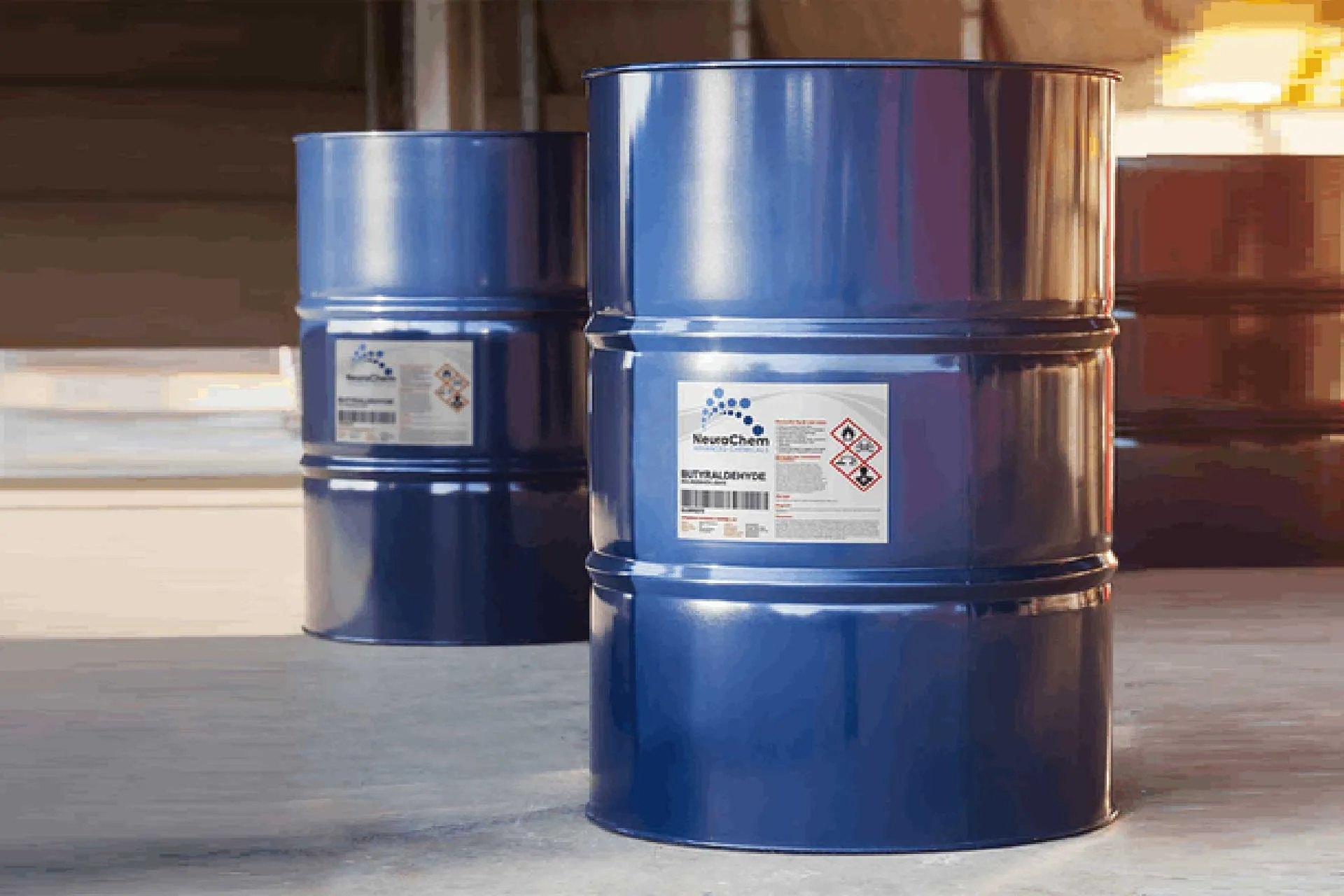
In most industries a label is a piece of marketing. In the chemicals industry it is a piece of regulation. A hazard label that is wrong or has become illegible is not a cosmetic slip — it is a compliance problem, with an inspector, a haulier or in the worst case an accident at the end of the chain.
That changes everything about the way you look at a label printer. Speed and colour quality are welcome, but the first question is: will this label hold up in the conditions it ends up in, and does it meet the standard?
To that question the NeuraLabel Callisto gives an answer that most label printers cannot. In this article we explain why.
The problem with outsourcing in the chemicals industry
Many chemicals businesses have their hazard labels printed by an outside printing house. On paper that is logical: they know the standard, supply certified material and print in large runs. In practice that model runs into four things.
Minimum orders. A printing house does not want to print two hundred labels; it wants to print two thousand. So you buy a year’s stock.
Changes. An adjusted formulation, a new CLP classification, an extra hazard statement: it happens more often than businesses expect. And at that moment your year’s stock of labels is worthless.
Languages. If you supply several countries, you need several language versions per product. Multiply that by your range and you have a stock problem instead of a label stock.
Lead time. Waiting two weeks for labels means that a production run ready today can only leave in two weeks’ time.
Printing in house removes those four problems in one go. But then the machine on your shop floor does have to do what the printing house did.
What the standard really asks
For hazardous substances carried by sea, BS5609 is the bar. That standard is mercilessly concrete: a label has to survive ninety days of immersion in seawater and still be legible afterwards, resist UV exposure, and pass an abrasion test without the print disappearing.
You do not achieve that with a good printer alone. Three things are needed at once:
- Pigment ink. Dye ink dissolves in water and fades under UV. Only pigment ink, where the colour stays on the surface in solid particles, survives those tests. The Callisto prints exclusively with water-based pigment ink, resistant to water, alcohol, acetone and other aggressive substances.
- Certified label material. The ink may meet the standard, but if the material underneath lifts off, the label will still not hold up. That is why we supply BS5609-certified material with the machine.
- A machine that can handle the format. And that brings us to the point most often overlooked in the chemicals industry.
Width: why chemical labels are large
Put a hazard label next to an ordinary product label and the difference leaps out. A GHS label has to carry pictograms large enough to be recognisable from a distance, plus signal words, hazard statements, precautionary statements, supplier information — and all of that often in two or three languages.
The result: where a product label gets by on ten centimetres, a hazard label usually starts at A5 format and runs up to A4 or A3, certainly on drums and IBC containers.
That is where a large part of the market rules itself out. Most industrial label printers stop at around 216 millimetres. The Callisto prints labels from under 25 millimetres up to 296 millimetres wide — A3 width — on the same machine. That means you print both the small labels on bottles and the large labels on drums with one machine, without a second machine or an outside printer for the wide work.
A pace that keeps up with your production
Chemical production rarely runs evenly. There are weeks with a handful of batches and there are days when a complete delivery has to be labelled in one go.
With a speed of up to 27 metres per minute — eighteen inches per second — the Callisto is built for that second scenario. A run of a few hundred wide hazard labels is a matter of minutes, not of half an afternoon. And because the machine works with both roll media and fanfold, it adapts to your way of working instead of the other way round.
At the same time there is no minimum run. If you have to print fifteen labels today for a single one-off batch, you print fifteen.
What that means in practice
Suppose: you produce industrial cleaning products in twenty variants, supply Belgium, the Netherlands and France, and work with packaging from five litres up to IBC containers.
Today that means: three language versions × twenty products × two label formats, all in stock, all to be reordered at every change in the formulation.
With your own machine that becomes: one label file per product, which you adjust when the formulation changes, and which you print at the moment the batch is ready — in the language and the format that batch needs. The stock you hold is blank material, and that does not go out of date.
That is the real gain. Not the cost per label — although that works out well in the long run too — but the fact that your labelling follows your production instead of the other way round.
And when is it not a Callisto?
To be fair: if you work with narrow labels in limited runs, and your label never goes outdoors or comes into contact with aggressive substances, then this machine is sized more generously than you need. Within the chemicals industry too there are applications — small bottles, internal identification — for which a lighter model is enough.
Not sure where your situation sits? Then work through our selection guide: five short questions about your label, your volume and your environment, and you get a reasoned recommendation. Prefer to talk it through straight away? Send us your label, material and run length — you get advice with no obligation, and on request we print a sample beforehand so that you have the result in your hands before you decide.